

ABB E-mobility Launches OM M-Series, Reframing Charging Infrastructure Around the Economics of Delivered Energy
The M-Series split system scales from 200 kW to 1.2 MW in field-upgradeable steps — designed for public fast-charging sites, commercial and transit fleet depots, and retail and destination charging sites, enabling operators to grow infrastructure in line with actual demand.
ZURICH, April 23, 2026 — As public charging networks transition from scaling charge points to operating high-performance infrastructure businesses, the competitive focus is shifting from installed capacity to delivered energy and site-level economics. ABB E-mobility today introduced the M-Series, a modular, air-cooled split-system architecture that separates power from dispensers — enabling charging systems to be configured around specific mission profiles rather than deployed as generic hardware.
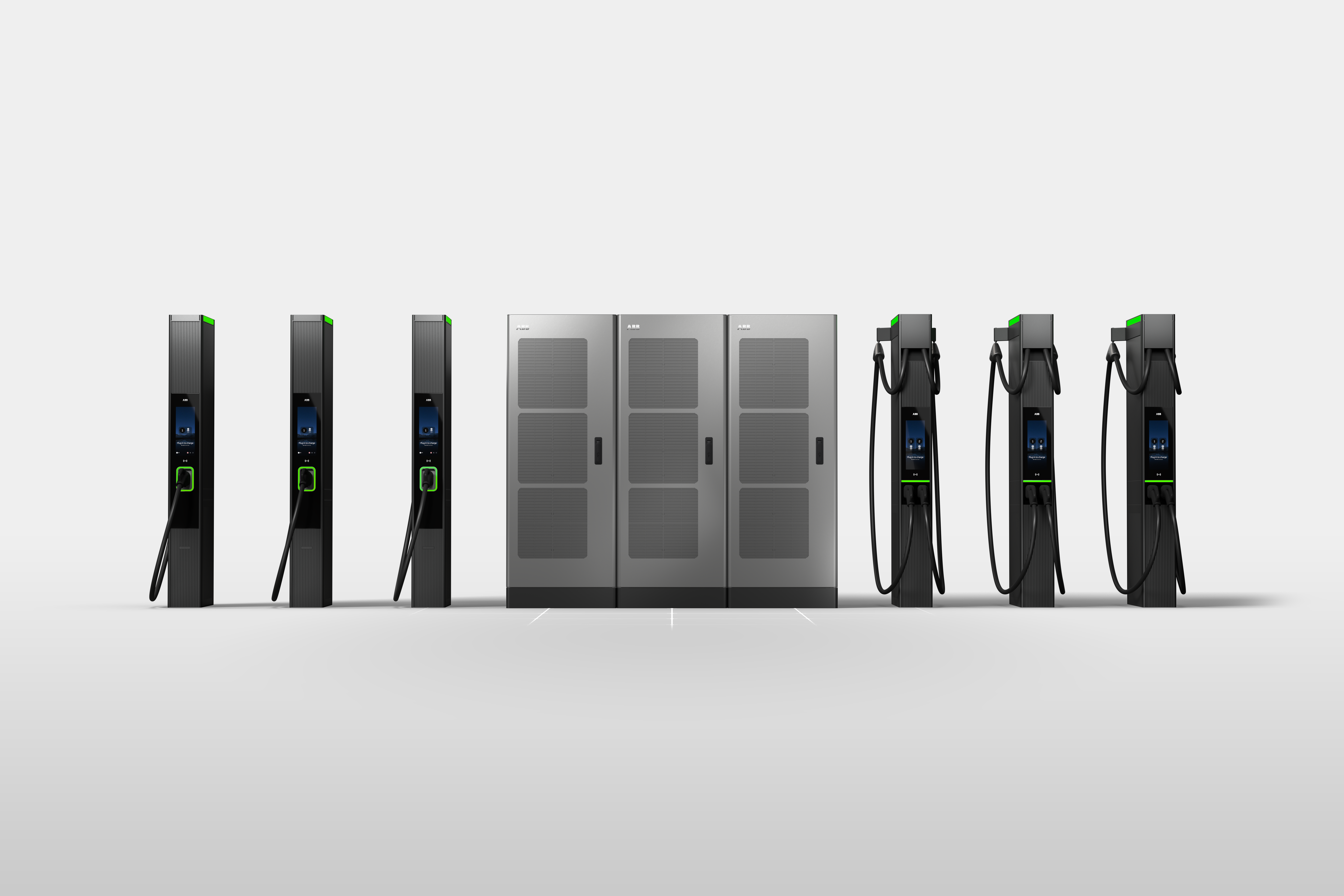
Power is no longer tied to individual charge points. The M-Series connects centralized power cabinets to a flexible portfolio of ChargePost dispensers — Solo, Duo, Dock and Ultra, supporting CCS1, CCS2, NACS and MCS — across 36 site configurations. This separation enables charging infrastructure to serve distinct customer segments, each with different utilization patterns, dwell times, and economic requirements.
“The industry spent a decade optimizing for nameplate power. What operators need to optimize for now is the cost of energy delivered over the lifetime of a site,” said Michael Halbherr, CEO of ABB E-mobility. “Power only matters if it can be consistently delivered — across vehicle architectures, across charge points, and across utilization levels. The M-Series is built to optimize that.”
At the core of the system is the power delivery architecture. Rather than provisioning installed power to match peak stall demand, the M-Series treats total installed power as a shared resource — dynamically allocating capacity across charge points and aligning delivery with real-time demand. Operators can reduce installed power requirements while maintaining high delivered power under load, lowering the cost of delivered energy and improving operational performance.
The M-Series scales from 200 kW to 1.2 MW, supporting up to 24 charge points without compromising peak charging. Power capacity can be expanded in the field in 400 kW increments across up to three interconnected cabinets — without site redesign or stranded investment — allowing infrastructure to scale in line with actual demand rather than projection.
With a power density of 625 kW per square meter — equivalent to 1,200 kW in 1.92 square meters — the system delivers more installed capacity within the same footprint than comparable high-power split systems. This directly improves site economics where space is constrained or land costs are high.
Delivered power — not rated power — is the relevant metric. Different EVs draw power differently, and conventional systems lose capacity in the handover. The M-Series maintains delivered power close to rated power across vehicle types, ensuring installed capacity reaches the vehicle.
Through dynamic power sharing, the system continuously allocates available capacity across all connected charge points, aligning output with real-time demand and maximizing the ratio of energy delivered to installed power as vehicle mix and arrival patterns change throughout the day.
Designed for how sites actually grow
The M-Series is built around three site typologies, each with different power requirements, utilization patterns, and economic constraints.
Public fast-charging corridors: Sites scale from a single 400 kW cabinet to 1.2 MW across up to 24 charge points in 400 kW increments — without redesign or rework. Every previously installed cabinet continues earning through each expansion phase. For CPOs managing hundreds of locations, capital allocation decisions can be evidence-based across a portfolio — committed when demand justifies them, not in advance.
Retail and hospitality destinations: At supermarkets, fuel retailers, and logistics hubs, the system dynamically balances between high-power charging at low utilization and parallel charging at higher utilization, maximizing capacity use as demand fluctuates. Operator branding, advertising, and digital commerce capabilities are integrated from the outset. Previously installed cabinets continue to generate value as sites expand.
Commercial fleet depots: Depot operators electrifying mixed van, truck, and bus fleets make capital commitments under genuine uncertainty — vehicle mix, electrification pace, and MCS readiness are all variables at the point of investment. The M-Series absorbs that uncertainty by enabling expansion in 400 kW increments, aligning infrastructure cost with actual fleet growth rather than projected fleet size. At any installed power level, the system supports both high-power opportunity charging and lower-power overnight charging without dedicated infrastructure for each mission — making an electrification program financially manageable at portfolio scale.
The M-Series integrates with ABB E-mobility’s asset operations platform, providing real-time visibility, AI-driven fault detection, and streamlined field service across configurations. It builds on the iF Design Award-winning HMI introduced with the A400 and C50, extending a consistent operator experience across the portfolio. Optional AC-coupled battery storage supports peak shaving and site-level energy flexibility where grid constraints apply. Open APIs and an SDK enable integration with existing operator systems and third-party platforms.
From all-in-one to split systems
The M-Series builds on the A-Series foundation and marks a structural shift in charging architecture. The A-Series establishes an all-in-one system for simple deployment and consistent high-power delivery across public and destination charging sites. The M-Series introduces a split-system design — separating power from dispensers and enabling use-case-specific configuration rather than generic deployment.
Both series are built on the same air-cooled, in-house-developed silicon carbide IP54 power electronics platform and a common reference architecture, commercially deployed since 2024. Investments compound across experience, power electronics, and electromechanical domains — enabling the M-Series to launch at high maturity.
About ABB E-mobility
As a global leader in electric vehicle (EV) charging solutions, ABB E-mobility is enabling a more sustainable and efficient mobility future. It is the preferred partner of the world’s leading EV original equipment manufacturers (OEMs), EV charging network operators, and fleet companies. ABB E-mobility offers the widest portfolio of EV charging solutions, including high-power chargers for destination charging, solutions for the electrification of fleets, and charging solutions for electric buses and trucks. ABB E-mobility employs around 1,400 people worldwide and has sold over 68,000 high-power chargers, electrifying more than 10,000 sites globally.
Media Contact
Phil Johnson
Regional Communication
Mail: phil.johnson@us.abb.com
Phone: +16305449799
Related Articles
Discover more content like this from across our newsroom


